
The Mother See of Holy Etchmiadzin
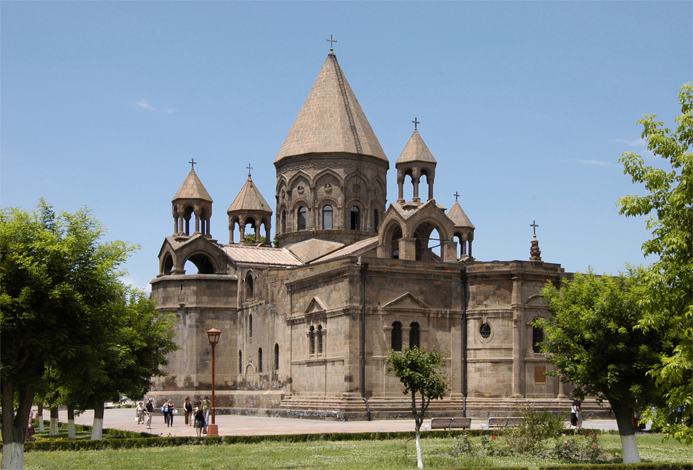
The Armenian Church, also known as the Armenian Apostolic Church, is an independent and autocephalous oriental-orthodox church that traces its origins to the first-century apostles Thaddeus and Bartholomew. It has a unique theology that, while rejecting the Council of Chalcedon's wording, is often understood by both Chalcedonian and non-Chalcedonian churches as a difference in terminology rather than core doctrine. The church has a rich tradition and a distinct architectural style, with its faith based on the Holy Tradition, which includes the Bible, liturgy, the writings of church fathers, and the creeds.
Beliefs and theology
The church teaches that Christ is both fully God and fully man in a single, unified nature (miaphysitism), a position that led to its rejection of the Council of Chalcedon in 507 AD. It is considered one of the Oriental Orthodox churches.
The Armenian Church recognizes seven sacraments: Baptism, Chrismation, Eucharist, Confession, Marriage, Holy Orders, and Anointing of the Sick.
The Nicene Creed is the main statement of faith, and the church accepts the first three ecumenical councils (Nicaea, Constantinople, and Ephesus).
Its faith is based on Holy Tradition, which includes the Bible, the writings of church fathers, and the ongoing life of the church through its liturgy, saints, and rituals.
Organization
Four Sees:
The church is structured around four main sees: two catholicosates (at Ejmiadzin and Cilicia) and two patriarchates (at Constantinople and Jerusalem).
Supreme Patriarch:
The Supreme Patriarch and Catholicos of All Armenians, who resides at the See of Ejmiadzin in Armenia, is generally recognized as the head of the entire church.
Autonomy:
Each of the four sees has administrative autonomy, though the patriarchates recognize the spiritual supremacy of Ejmiadzin.
Distinctive practices and heritage
Liturgy:
The liturgy is distinct and includes unique melodies and rituals, such as the blessing of the four corners of the world. The liturgical language is a unique Armenian language called Kraar.
Architecture:
The Armenian Church has its own distinctive and ancient architectural style, with many ancient monasteries serving as prime examples.
History:
The church has a long and complex history, including facing persecution and genocide in the 20th century.